Is Wireless Festival Returning in 2027? What We Actually Know
Is Wireless Festival returning in 2027? After the 2026 cancellation over Kanye West, here is what we know about Wireless's future at Finsbury Park.
The short answer: almost certainly, and the paperwork now points well beyond 2027. Wireless, London's biggest rap and hip-hop festival, did not happen in 2026, cancelled at short notice in one of the most dramatic festival collapses in recent British history. The weekend of 10 to 12 July was when it should have been filling Finsbury Park. With the site left quiet, the obvious question is whether Wireless comes back in 2027, and the more interesting question is what it has to change if it does. The good news is that the structures for a return are not just in place, they were quietly extended this spring. The harder truth is that the 2026 cancellation exposed a booking strategy that Wireless cannot afford to repeat. This is a working DJ and producer's read on where Wireless stands, separating what is confirmed from what is reasonable to expect. The facts below were checked against current sources in late September 2026.
Wireless Festival 2027 at a glance
- Officially confirmed? No. As of late September 2026, there are no announced 2027 dates, line-up or tickets. Festival Republic has said only that Wireless "will return", with no year attached.
- Likely to return? Yes. In March 2026, Haringey Council approved a further five-year contract with Festival Republic for major events in Finsbury Park, running through to 2032, so the legal home is secured well past 2027.
- Why 2026 was cancelled: the UK Home Office denied headliner Ye, formerly Kanye West, entry to the country, leaving the festival without its booked act for all three nights.
- Refunds: all 2026 ticket holders were confirmed for automatic full refunds.
- The track record: Wireless has run every year since 2005 apart from 2020, lost to Covid, and 2026.
- How to stay informed: announcements will come via the official Wireless channels, with line-ups typically revealed between late January and March ahead of a July festival.
The 2026 cancellation, in short
To understand 2027, you have to understand the collapse. On 7 April 2026, organiser Festival Republic announced that Wireless, scheduled for 10 to 12 July 2026 at Finsbury Park, would not go ahead. The trigger was a government decision: the UK Home Office denied entry to headliner Ye, with ministers rescinding his travel permission on the grounds that his presence would not be "conducive to the public good". We covered the full story when it broke, in why Wireless 2026 was cancelled.
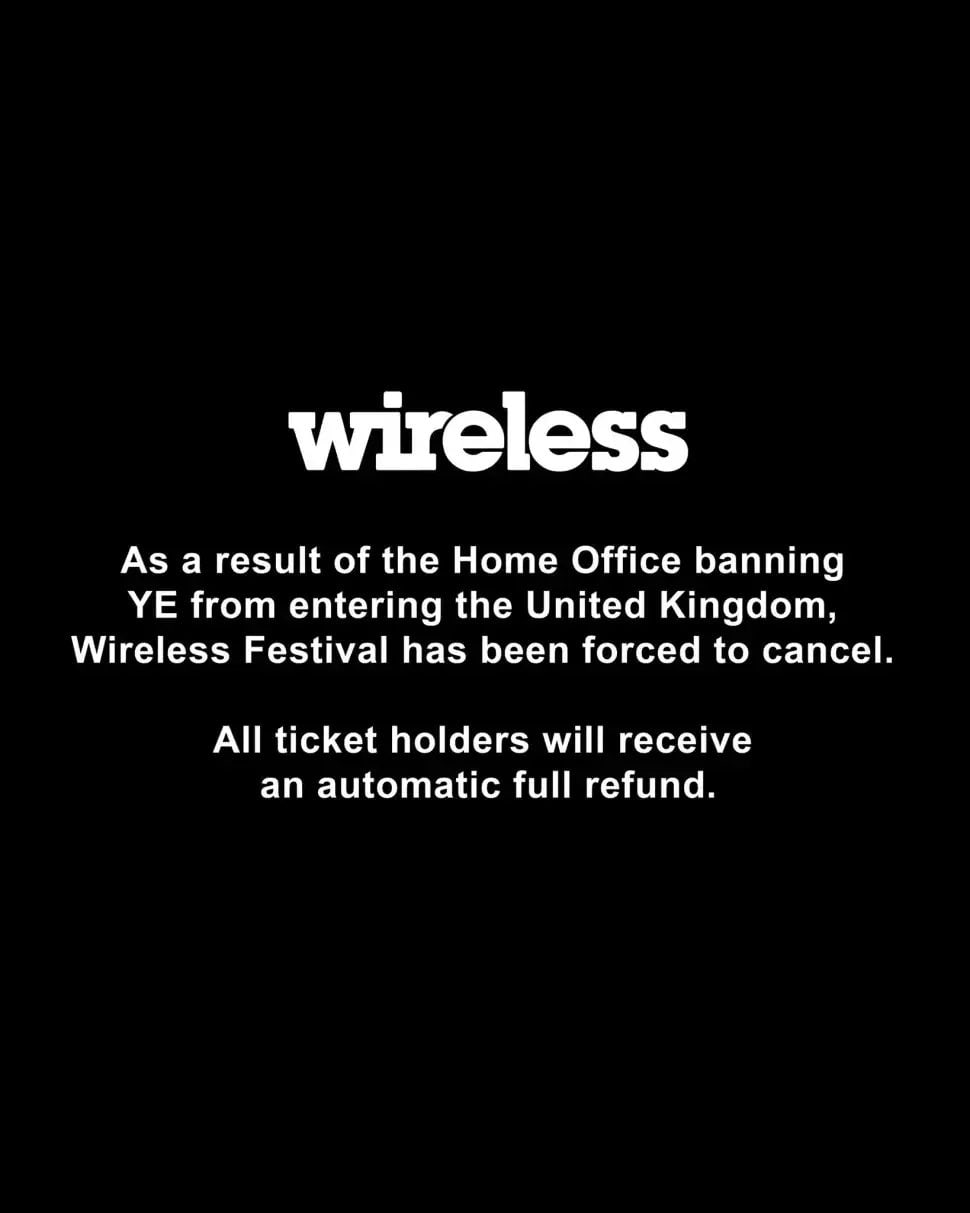
The damage cascaded from there. Ye had been booked to headline all three nights, so his removal left three enormous gaps in the schedule with only about three months to fill them. Within a week of the 30 March line-up reveal, sponsors had begun to walk: main sponsor Pepsi withdrew on 5 April, and Diageo, PayPal and Rockstar Energy pulled back on 6 April, per NME. Facing a hole at the top of every night and a flight of commercial partners, Festival Republic pulled the event entirely and refunded ticket holders. It was less a single failure than a chain reaction.
So is Wireless coming back in 2027?
On the balance of evidence, yes. Wireless has been an almost unbroken fixture of the London summer since 2005, surviving venue moves and changes of musical identity, and a one-year cancellation is far more likely to be a blip than an ending. Crucially, the framework does not just remain, it was extended after the collapse. Festival Republic, the Live Nation division behind the event, signed a five-year deal with Haringey Council in 2023 to host Wireless at Finsbury Park through 2027. Then, on 20 March 2026, just weeks before the cancellation, the council approved a further five-year contract with Festival Republic for major Finsbury Park events, running through to 2032. That is the detail almost nobody has reported, and it is the strongest signal available: the venue, the promoter and the council are locked in for years, and a cancelled 2026 does not change the paperwork. There is no venue or permission obstacle to a 2027 return. The one lingering complication is local: residents' groups have campaigned for years against Wireless taking over Finsbury Park, citing noise and loss of public park access, and that opposition has not gone away.
What is missing is a public commitment. Organisers have so far declined to say whether 2027 will proceed as normal, be restructured, or address the questions the 2026 collapse raised. That silence is understandable so soon after a refund-triggering cancellation, but it means anyone claiming firm 2027 dates or a line-up right now is guessing. The honest position is that a 2027 return is highly likely, not confirmed.
The full timeline: what has actually happened since 7 April
Most reporting stopped the week the festival fell over. What follows is checked against council records, trade press and interviews, rechecked in late September 2026.
- 20 March 2026: Haringey approves the further five-year contract taking the Finsbury Park arrangement to 2032, signed off at a Cabinet Member Signing under the then Labour administration, seven weeks before the borough elections.
- 7 April 2026: Festival Republic cancels Wireless after the Home Office withdraws Ye's travel permission, and confirms automatic refunds. The eight-day sequence that got there is covered separately.
- 10 April 2026: Festival Insights reports John Rostron of the Association of Independent Festivals estimating around £30m of lost turnover: "Wireless is roughly 50,000 people. You're talking about a show that has got to be turning over around £10m a day, that would be a sensible guess".
- 8 May 2026: all results are declared in the Haringey borough elections: 28 Green seats, 21 Labour and eight Liberal Democrat, leaving the borough under no overall control.
- 21 May 2026: the Green group takes control as a minority administration under Cllr Mark Blake, with Cllr Erin Wolson holding culture and leisure.
- 29 June 2026: Haringey publishes resident information for the park's 2026 events, including a hotline staffed to 2am on show days.
- 3 to 5 July 2026: Finsbury Park stages Festival Republic's other three-day weekend, with Biffy Clyro, Kasabian and Wolf Alice. Site, crew and licence all functioned normally. Only Wireless was missing.
- 10 July 2026: North West Londoner reports campaigners pressing for transparency, noting that build ran from 24 June, the shows from 3 to 5 July and breakdown to 10 July, with much of the park's green space inaccessible throughout.
- 10 to 12 July 2026: the dates Wireless should have run.
- 15 July 2026: NME publishes an interview with Festival Republic managing director Melvin Benn on the festival's future.
- Late September 2026: the official Wireless site still carries no 2027 dates, line-up or tickets.
What the promoter has actually committed to
There is one on-the-record commitment. Speaking to NME on 15 July, Benn said: "I think timing is an important one, but Wireless will return. We're very confident about that." Asked what he had learned, he answered "Timing, I think, is an important lesson", adding that he hoped others would "learn the lesson of forgiveness". Billboard picked the same interview up.
That is a commitment to the festival existing again, not to a year. Benn named no date, no site, no format and no artist. "Very confident" is promoter language for intent, softer than the wording a company uses once the diary is booked. Our reading, and it is a reading rather than a fact, is that Festival Republic is holding 2027 open while the temperature settles.
Haringey changed hands in May, and that changes the room
The contract securing the park through 2032 was signed off in March by a Labour administration. Seven weeks later that administration lost the borough, and the Greens, who had criticised the process behind the deal, now run Haringey as a minority administration. That undoes nothing, because a signed hire agreement is inherited rather than reopened, and there is no suggestion the council intends to reopen it. What changes is the scrutiny. Cllr Ruairidh Paton, now co-deputy leader, told North West Londoner in July that "Finsbury Park belongs to all of us, and so does the right to know how it's used, who benefits and where the money goes". That reads less as a threat than as a promise of more published detail and a stakeholder process harder to wave through.
There is a blunt counterweight in the accounts. Haringey says it takes around £1.2m a year on average from Finsbury Park events, all reinvested in the park, paying for a park manager and a year-round maintenance team, plus an environmental impact fee it says has put £300,000 into community projects over nine years. In an interview with On London published on 20 July, Blake set out a council needing £80m of emergency borrowing this year on top of £50m already taken. A council in that position does not walk away from £1.2m of park income. Add the London Borough of Culture title in 2027, and the incentives point towards a working festival summer.
The licensing picture underneath the contract
Two separate pieces of paper have to line up before Wireless can happen, and most coverage collapses them into one. The first is the park hire agreement with the council, which made the March headlines. The second is the premises licence for Finsbury Park, held by Live Nation, governing hours, sound, security and welfare.
The hire side was framed by a June 2023 council decision giving Festival Republic in-principle agreement to hire the park for two consecutive three-day weekends a year, one of them Wireless, across 2023 to 2027, with annual reviews involving ward councillors and the Friends of Finsbury Park. That two-weekend structure is why the park still had a July 2026 bill without Wireless on it, and the site's diary runs well beyond it, with Sammy Virji headlining a Krankbrother day in the park on 7 August.
The licence has already been tested. The Friends of Finsbury Park applied to review Live Nation's premises licence, and a special licensing sub-committee sat over two days in October 2018. It refused to revoke, but tightened the terms: 16 existing conditions amended and 36 new ones, four of those agreed with Islington Council, which then withdrew its objection, the park sitting where three boroughs meet. Sound at the approved measurement locations was capped at 75dB(A) measured as a 15-minute LAeq, low frequency music limited to 85 dB Leq over 15 minutes in any one-third octave band from 40Hz to 125Hz, and the Sunday terminal hour pulled back by half an hour, with regulated entertainment ending at 21:30. The Hackney Gazette quoted campaign chair Simon Hunt saying "We are certainly pleased at least some of our conditions were listened to".
Two things follow for anyone who works these shows. A ceiling across the 40Hz to 125Hz bands is the most consequential line in the document for a DJ, because it dictates how the rig is tuned and how much room a sub-heavy set really has. And a shortened Sunday is why the final day runs tighter. Both travel with 2027. The broader legal argument was settled a decade ago, when the same campaigners took Haringey to judicial review over Wireless 2016 and the Court of Appeal upheld the council's power to hire the park out. The opposition is organised and going nowhere, but it shapes conditions rather than existence.
How long comparable festivals take to come back
The most useful way to judge a 2027 return is to look at festivals that miss a year. Four returns and one that never came.
- Wireless itself, 2020 to 2021. The pandemic edition was lost and the festival came back on 10 to 12 September 2021, two months later in the calendar and at Crystal Palace Park rather than Finsbury Park.
- Glastonbury, 2026 to 2027. A planned fallow year, but instructive on notice: the 2027 dates of 23 to 27 June were announced on 25 September 2025, around 21 months ahead.
- WOMAD, 2025 to 2026. No edition in 2025 while the festival moved, with its return set for 23 to 26 July 2026 at Neston Park Estate near Corsham, after holding it at Charlton Park since 2007.
- Cambridge Folk Festival, 2025 to 2026. The four-day festival cancelled its 2025 edition, which would have been its 60th, while organisers explored new options, then came back in 2026 as a run of fringe events around the Cherry Hinton Hall weekend. Restructured rather than restarted.
- Astroworld, 2021 to nothing. The counter-example: Travis Scott's Houston festival has not run since the 2021 crowd disaster.
The pattern, and this is our reading rather than a rule, is that a single missed year is normal where the underlying business is sound, that confirmation lands between nine and 21 months before the gates open, and that the returning edition is often smaller, restructured or relocated rather than a straight restart. Festivals that never come back are the ones where the brand itself became the problem. Wireless's problem was one booking.
The real lesson: the all-eggs-in-one-headliner gamble
Here is the part worth dwelling on, because it is the actual story. Wireless 2026 did not fall because of bad weather or weak sales. It fell because the entire festival had been built on a single artist booked across all three nights, and when that one booking became impossible, there was no plan B. The model concentrated all the risk in one person.
It was not the first time Wireless had handed an artist all three nights, Drake famously did it, and triumphantly, so the strategy can work spectacularly when everything goes right. But the Ye situation showed the catastrophic downside: tie your whole weekend, and your sponsor relationships, to one headliner, and you inherit every risk attached to them, from visa status to brand safety. A festival that diversified its top line across several major names would have lost a headliner and carried on. Wireless lost its headliner and lost the festival. That is the lesson any 2027 edition has to absorb.
What a 2027 Wireless needs to do differently

If Wireless returns, the smart rebuild is obvious in outline. Spread the headline risk across multiple major artists rather than betting the weekend on one. Rebuild sponsor confidence with bookings that are commercially stable as well as exciting. And lean back into what Wireless is genuinely great at: being the UK's flagship stage for rap, grime, drill and Afrobeats, a role no other London festival fills at the same scale. Its strength was never a single superstar. It was being the place the culture gathers, and that identity is exactly what a post-2026 reset should protect.
There is an opportunity here too. A cautious, well-curated, multi-headliner 2027 line-up that puts the music and the scene first, rather than chasing one box-office name, could rebuild trust faster than another high-risk spectacle. London's festival and club ecosystem is competitive, with everything from Drumsheds' warehouse-scale events to the city's grassroots club rooms fighting for the same nights out, and Wireless cannot assume it will simply be forgiven. It has to earn the comeback.
What a returning Wireless would realistically look like
Nothing here is confirmed. It is what the paperwork, the site and the sector make likely, set out so you can measure a real announcement against it. Expect Finsbury Park. The contract runs to 2032, the licence sits with Live Nation, the crew know the ground, and the 2026 concert weekend proved the operation still works. Expect early to mid July, where the festival has sat in every Finsbury Park year, which would put it within a fortnight of a returning Glastonbury. The two coexisted for years, but it tightens artist routing and drops two very large bills into one month of household spending. Expect the established scale of just under 50,000 a day rather than a downsizing, because the fixed costs of building that site do not fall much if you sell fewer tickets.
The bill is where the change should show. Three separate top lines across three nights is the obvious correction, and the honest test of a rebuilt festival is not who closes Saturday but how deep the second and third tiers run. On sponsorship, after four sponsors walked within eight days of the line-up reveal, a quieter naming arrangement or none at the top is the sensible read. A locally facing edition also looks likely, given the Borough of Culture title and the local hiring already built into the arrangement.
One thing it will not include is the 2026 headliner. An Electronic Travel Authorisation is a security clearance rather than a visa, and as the law firm Freeths set out, refusals rest on a broad public good test, and critics it cites point to "the absence of a formal appeal mechanism". Nothing published puts an end date on it.
When will Wireless 2027 be announced, and what about tickets?
If Wireless follows its usual rhythm, expect any confirmation and dates to surface over the winter, a line-up announcement between late January and March 2027, and the festival itself in early-to-mid July. Tickets typically go on sale shortly after the line-up reveal, often with early-bird tiers before single-day and weekend options. As of late September 2026, none of that has been announced, and there are no official 2027 tickets on sale. The only reliable way to know the moment it is confirmed is through the festival's official website and social channels; treat anything else as speculation. One under-used tell: the council paper trail often moves first, because Haringey publishes its Finsbury Park events pages, resident letters and stakeholder papers, and hire and licensing items surface in agendas before any public line-up. A leaked bill with no on-sale mechanism is gossip.
FAQ
Is Wireless Festival happening in 2027?
It has not been officially confirmed, but it is widely expected to return. Haringey Council approved a further five-year Festival Republic contract for Finsbury Park events in March 2026, running through to 2032, and the festival has been an annual fixture since 2005 apart from 2020, lost to Covid, and 2026.
Why was Wireless 2026 cancelled?
The UK Home Office denied entry to headliner Ye, formerly Kanye West, who had been booked to headline all three nights. With the top of every night suddenly empty and sponsors withdrawing, Festival Republic cancelled the event and refunded all ticket holders.
Where is Wireless Festival held?
Finsbury Park in north London, its home since 2014. Haringey Council's arrangements with Festival Republic for major park events now run through to 2032, after a further five-year contract was approved in March 2026.
When will the Wireless 2027 line-up be announced?
No date has been set. Recent Wireless line-ups were revealed between late January and March ahead of a July festival, so any 2027 announcement would most likely come in late 2026 or early 2027.
Can I buy Wireless 2027 tickets yet?
No. As of late September 2026 there are no official 2027 dates or tickets on sale. Buy only through official channels once the festival is confirmed.
Has Festival Republic confirmed Wireless will come back?
It has committed to a return, but not to a year. Speaking to NME on 15 July 2026, Festival Republic managing director Melvin Benn said "I think timing is an important one, but Wireless will return. We're very confident about that." No date, site or line-up was named.
Does Haringey's new council put Wireless at risk?
There is no evidence that it does. The Green minority administration that took control on 21 May 2026 had criticised the process behind the five-year contract, but that contract was signed in March and runs to 2032, and the council reports around £1.2m a year of income from park events. Expect closer scrutiny rather than a cancellation.
Sources
- Official Charts, Music Week and Music Business Worldwide on the 7 April 2026 cancellation and the Home Office decision on Ye
- Haringey Council's 20 March 2026 announcement of the further five-year Festival Republic contract for Finsbury Park events through 2032
- Wikipedia and Complete Music Update on Wireless's history, Finsbury Park move and the 2023 Festival Republic licensing deal through 2027; Islington Gazette and local campaign coverage of resident opposition to Wireless in Finsbury Park
- Radical Storage and Hounslow Herald summaries of the cancellation, sponsor withdrawals and refund process; NME, 6 April 2026, on the Pepsi, Diageo, PayPal and Rockstar Energy withdrawals
- Wireless Festival official channels for the absence of any confirmed 2027 announcement
- NME's 15 July 2026 interview with Melvin Benn and Billboard's report of it; Festival Insights on John Rostron's £30m turnover estimate
- Haringey Council on the May 2026 election results, the Green minority administration, the March 2026 contract and the 2026 events programme, and council minutes for the June 2023 park hire decision and the October 2018 licensing review
- Hackney Gazette on the licence review outcome; Local Government Lawyer on the Friends of Finsbury Park court challenges
- North West Londoner on park closures, July 2026; On London's interview with council leader Mark Blake; Freeths on the Electronic Travel Authorisation system; Glastonbury and WOMAD announcements, BBC News (17 January 2025) and Cambridge Folk Festival for comparable return timelines
This guide is part of House of MNEEMO's ongoing coverage of the electronic and club music scene, written by London-based DJ and producer MNEEMO, with millions of streams to his name and a party series running through some of London's best clubs.